
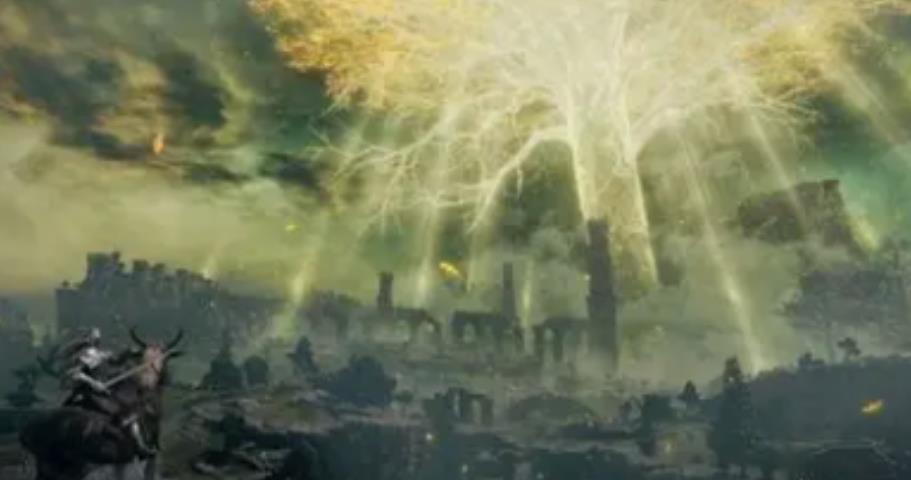
I first stepped into the Lands Between without any preparation, without any expectation, carrying only a vague sense that this would be a game unlike any I had ever experienced. Even after watching trailers, reading previews, and knowing that this was a collaboration between Hidetaka Miyazaki and George R. R. Martin, nothing could have prepared me for the profound, almost unsettling depth of this world. The Lands Between does not greet you with grandeur or flourish; it does not extend a hand to guide you. It exists in silence, in scale, in quiet defiance of your presence. When I emerged from the dim cave, the sunlight filtered through fractured clouds, falling in shards across the grass, and in the distance, the golden tree shone like a living monument to an age long past, a time long forgotten. The world did not speak. It did not offer instructions. It did not acknowledge me. It simply was. And yet, in that silent presence, I was drawn into something far deeper than any ordinary adventure, a journey that would remain embedded in my memory long after I had set down the controller.
The Lands Between is a world without mercy or guidance. It does not exist for the player, nor does it bend to the whims of any individual. There are no signs to point you forward, no gentle cues to tell you where to go. You must interpret the scattered ruins, abandoned villages, broken walls, and faint traces of lives long past. When I first saw the Tree Sentinel patrolling the sunlit plains of Limgrave, its golden armor reflecting a blinding light, I did not perceive it as a designed boss placed deliberately for me. It felt alive, as if the land itself had given birth to a guardian. It would not spare you for being a novice; it would strike and kill, each swing a lesson, each feint a test: this world does not care for you, yet it demands that you adapt. And in that demand lies its strange, compelling beauty. It is harsh, unforgiving, and yet it rewards the player in a way few games ever attempt. There is no shortcut to understanding; you must earn your place in this world, and in doing so, you are transformed.
The first stretch of my journey through Limgrave felt almost cinematic. Rolling hills stretched into the horizon, dotted with crumbling fortresses and half-collapsed bridges, where skeletal remains hinted at battles fought long ago. Morning mists hung low over the valleys, blurring the line between land and sky, and the wind whispered through the tall grasses, carrying faint echoes of distant creatures. In the forested enclaves, shafts of sunlight pierced the canopy, illuminating patches of moss-covered stones as if revealing forgotten secrets. Every corner of this landscape invited exploration, and every corner concealed danger. Players online often shared similar experiences: one recounted approaching a seemingly quiet hilltop only to be ambushed by a group of undead archers, their coordinated attack leaving him stunned, yet exhilarated at having survived. Another described wandering into a dense fog near the Mistwood, losing all sense of direction, yet discovering a hidden altar bathed in silver light, untouched and hauntingly beautiful.
Beyond Limgrave lies the forbidding expanse of Caelid, a land marked by rot and decay. Crimson haze fills the air, and the ground itself seems to bleed beneath your feet. Here, the weather feels like a constant reminder of the world’s corruption: sweltering heat one moment, sudden acidic rain the next, with wind gusts so strong they push against you, making every step a struggle. A fellow traveler recounted witnessing the scarlet rot slowly engulf a fallen knight, turning his armor into grotesque, writhing shapes, and how he felt simultaneously repulsed and strangely fascinated. In this realm, beauty and horror coexist in uneasy balance; it is a land that teaches caution, patience, and respect for the unknown.
The journey across Caelid eventually leads to the underground catacombs, where the atmosphere is suffocating and heavy with the scent of damp stone. Water drips endlessly from jagged stalactites, forming shallow pools that mirror the faint light of phosphorescent fungi. One player recounted spending hours in these tunnels, careful not to wake the lurking horrors, only to stumble upon a solitary inscription: “Hope is a flame that never dies.” In that instant, the catacombs felt less like a dungeon and more like a living chronicle of the world’s memory, where every death, every failure, and every small victory had been etched into stone.
To the north lies the frigid peaks of the giants, capped with eternal snow, where blizzards whip through jagged cliffs and the cold bites through even the thickest armor. Riding Torrent across the frozen plains, I felt both insignificance and awe; the wind seemed to carry the voices of ancient beings long forgotten. One player wrote about wandering through this region alone, disoriented in a whiteout, only to find a partially frozen monument to a god whose name had been erased by time. At that moment, the player described feeling an almost spiritual connection to the history and melancholy of the land—a sensation echoed by countless others traversing this expansive frozen wasteland. The weather here is a character in itself, shaping movement, strategy, and the psychological experience of exploration. The drifting snowflakes, the sudden gusts, the eerie silence—they combine to create a sense of isolation, of grandeur, and of fragile mortality.
The capital city of Leyndell represents another chapter in this journey, a sprawling metropolis suspended between grandeur and ruin. Tall spires catch the golden sun, while the streets below are littered with remnants of long-past conflicts. The atmosphere shifts with time and season: in the morning, the city glows with solemn majesty; by night, shadows stretch unnaturally, hiding threats and mysteries in every alleyway. Players have shared tales of wandering these streets at night, only to be suddenly pursued by relentless invaders, or unexpectedly assisted by summoned allies. These interactions, transient yet impactful, create a narrative within the narrative, adding layers of human emotion to an already dense world. One story recounted a player being ambushed by a red phantom, only to survive due to a message left by a previous traveler: “Attack from the side.” That single piece of advice saved hours of struggle and became part of the community’s shared memory, exemplifying how the game’s ecosystem encourages cooperation even among strangers.
The journey through Elden Ring is as much internal as external. Each battle is a meditation on fear, skill, patience, and growth. Bosses are not merely obstacles—they are instruments of teaching. Malenia, Blade of Miquella, for example, is less a foe and more a test of composure and adaptability, each phase a separate lesson in timing, strategy, and endurance. Encountering the Fire Giant in the open fields teaches ceremony and attention to environmental cues, while facing the Rotten conveys the importance of pacing and observation. Death is never simply punishment—it is dialogue. Each fall, each setback, instructs the player, reveals the land’s rules, and rewards careful attention and persistence.
Beyond combat, Elden Ring excels in environmental storytelling. From the ruins of Stormveil Castle to the mystical forests of Mistwood, from the sun-bleached cliffs of Liurnia to the frozen tundra of Mountaintops of Giants, every location tells a story. Seasonal shifts and weather patterns change not just the aesthetic but the player’s perception: a once-safe route may become treacherous under snow, a hidden cavern revealed only by the dim light of a rainy afternoon, a forest rendered mysterious by drifting fog. Players frequently share anecdotes of moments when the environment itself altered the meaning of their journey: a sudden rainfall revealing inscriptions carved in stone, a gust of wind carrying distant bell tolls that seem to echo a long-lost legend, or the haunting quiet of a frozen lake reflecting auroras above.
The Lands Between is also defined by its deities, demi-gods, and ancient civilizations, whose tragic fates resonate in every corner. Each enemy is not merely an obstacle; they are echoes of corrupted power, twisted by time and circumstance. Players often describe a strange empathy or melancholy during these encounters—feeling the weight of lost ambition, grief, and history pressing down with every swing of a sword. It is a world in which narrative and gameplay are inseparable; surviving, exploring, and understanding are acts of storytelling themselves.
Finally, the journey leads to the golden tree, a symbol both of hope and of the immense weight of the world. Standing beneath its radiant canopy, one is struck by awe, reflection, and an almost spiritual reverence. The adventure does not end with the final boss. It ends with understanding, with transformation. You leave the Lands Between not as the same person who first emerged from a cave, but as someone who has lived in myth, felt the pulse of a world’s history, and carried its stories within yourself. Players across the world echo this sentiment: “You are not playing Elden Ring. You are experiencing Elden Ring.” It is a journey of fear, of perseverance, of revelation, and of profound wonder. And the Lands Between waits, eternal, for those who wish to return.



Leave a Reply