
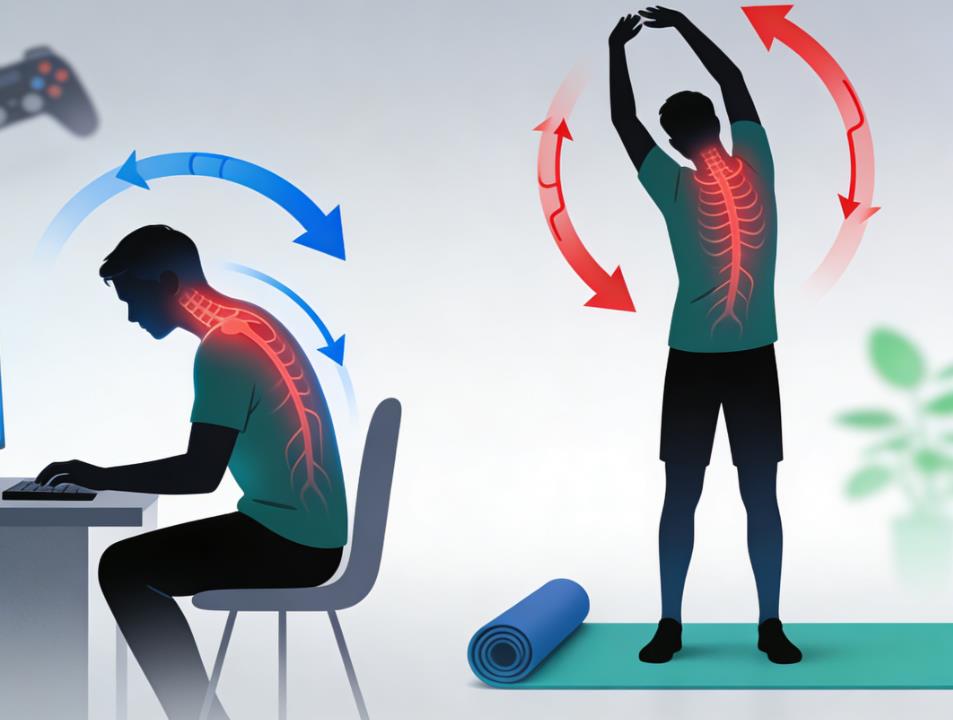
In an era where digital entertainment is ubiquitous, sedentary gaming has emerged as a dominant leisure activity across adolescents and adults alike. While the social and cognitive aspects of gaming can promote coordination and strategic thinking, extended periods of inactivity — especially when combined with poor posture — represent a growing public health concern. A sedentary lifestyle, characterized by prolonged sitting and low energy expenditure, has been linked to an increased risk of obesity, metabolic syndrome, chronic neck pain, and spinal dysfunction.
This article explores the long‑term health impacts of sedentary gaming, with a focus on musculoskeletal, metabolic, and cardiometabolic outcomes. Drawing on exercise science and clinical evidence, we outline practical, evidence‑based movement strategies (“active gaming breaks”) to mitigate these risks. We also provide actionable guidance on optimizing gaming ergonomics and integrating posture‑focused exercises into the daily routine.
Sedentary Gaming as a Health Risk: What the Evidence Shows
Sedentary Behavior and Obesity Risk
One of the most documented consequences of prolonged sitting is the increased risk of excess body fat accumulation and obesity. Energy expenditure during seated gaming is minimal, often below 1.5 metabolic equivalents (METs). Over time, this low energy consumption contributes to positive energy balance — where caloric intake consistently exceeds caloric expenditure — and weight gain.
Studies in physical activity epidemiology demonstrate that sedentary screen time is an independent predictor of waist circumference, body mass index (BMI), and adiposity in youth and adults, even after adjusting for leisure physical activity levels. The connection to obesity is not merely cosmetic: adipose tissue — particularly visceral fat — drives inflammation and insulin resistance, raising the risk for type 2 diabetes and cardiovascular disease.
Extended gaming sessions without activity breaks contribute to energy imbalance, ultimately increasing the obesity risk and associated metabolic complications.
Impact on Metabolic Health
Beyond weight gain, sedentary behavior exerts profound effects on metabolic regulation. Prolonged sitting decreases the enzyme responsible for clearing triglycerides, which can lead to dyslipidemia. Sitting for hours without muscle contraction diminishes glucose uptake by skeletal muscle, promoting insulin resistance. Chronic inactivity is also associated with elevated C‑reactive protein and other inflammatory cytokines.
These factors collectively contribute to features of metabolic syndrome, an umbrella term for a cluster of conditions including hypertension, dyslipidemia, insulin resistance, and abdominal obesity — all of which can persist unnoticed in gamers who appear outwardly “healthy.”
Musculoskeletal Strain: Neck, Shoulder, and Spine Health
Perhaps the most immediately felt consequence of long gaming sessions is musculoskeletal discomfort. The combination of forward head posture, rounded shoulders, and static spinal loading places significant mechanical stress on the cervical and lumbar spine.
Forward head posture increases the effective weight of the head on the cervical spine — for every inch the head moves forward, the cervical load increases by approximately 10 pounds. Over time, this contributes to intervertebral disc compression, muscle imbalance between deep neck flexors and posterior neck extensors, and increased risk of cervicogenic headaches. This constellation of symptoms is often classified as chronic neck pain, prevalent in individuals who spend hours gaming without positional variation.
Unsupported sitting increases disc pressure in the lumbar region, and when compounded by slouched posture, can accelerate degenerative changes. The result is lower back discomfort, persistent stiffness, and reduced functional mobility.
Why Traditional Exercise Isn’t Enough Alone
It might be intuitive to think that going to the gym for one hour offsets six hours of sitting — but exercise does not fully counteract the health risks of prolonged sitting. This concept, often called the “active couch potato” phenomenon, suggests that even physically active individuals experience metabolic and musculoskeletal strain when long bouts of uninterrupted sitting are present.
Frequent movement breaks are essential, even for individuals who meet daily physical activity guidelines outside of gaming hours.
Introducing “Active Gaming Breaks”: Science‑Backed Movement Strategies
To counteract the physiological and biomechanical risks of sedentary gaming, the solution isn’t just “move more after you finish gaming.” Instead, gamers need scheduled, intentional activity breaks that address posture, cardiovascular stimulation, and muscle activation.
Break Frequency and Timing
Research in occupational health suggests that short, frequent breaks are more beneficial than fewer long breaks. A common guideline is five minutes of movement every 30 minutes or ten minutes every 60 minutes. The goal is to interrupt static posture before neuromuscular fatigue and metabolic slowdown set in.
Movement Selection: Combining Cardiovascular and Postural Exercises
Active breaks should integrate both cardiovascular activation and posture correction exercises.
Cardiovascular Activation: Activities like brisk marching in place or jumping jacks increase heart rate, promote blood flow, and improve glucose metabolism. Even brief bouts of vigorous activity can improve post‑meal glucose regulation and stimulate metabolic pathways suppressed by sitting. Examples include 60 seconds of high knees, 30 seconds of jump rope, or a quick stair climb.
Posture Correction and Spinal Mobility: To combat neck and spine strain, active breaks need targeted exercises. Posture activation exercises include band pull‑aparts or scapular retractions to strengthen upper back muscles, chin tucks to reinforce cervical alignment, thoracic spine rotations to improve upper back mobility, and hip flexor/hamstring stretches to reduce anterior pelvic tilt and lumbar compression. Integrating these movements helps balance muscular forces, reduce compressive stress on vertebral discs, and improve overall spine health.
Example Active Break Protocol
A sample routine every 20 minutes could include: 0–20 minutes of gaming, followed by 3 minutes of marching in place, shoulder rolls, and chin tucks; then another 20 minutes of gaming, followed by high knees, band pull‑aparts, and hip flexor stretches. This pattern maintains metabolic activation and muscular engagement while fitting naturally between game rounds, load screens, or level transitions.
Ergonomic Optimization for Gaming Setups
Ergonomics plays a pivotal role in reducing musculoskeletal strain independent of physical breaks. Chair and seat positioning should allow feet to rest flat on the floor, thighs parallel to the ground, and lumbar support to maintain the spine’s natural curve. Monitor placement should have the top of the screen at or slightly below eye level, at an arm’s length distance to avoid forward head posture. Input devices should allow elbows to remain at approximately 90 degrees with neutral wrists, minimizing shoulder and wrist strain. A well‑designed ergonomic gaming setup not only increases comfort but also supports spine health and decreases chronic neck pain.
Breaking the Cycle: Behavioral Strategies for Sustainable Change
Despite knowing the risks and solutions, many gamers struggle to change entrenched habits. Behavioral science offers practical adherence strategies. Setting timers or wearable prompts every 20–30 minutes enforces active breaks, while pairing breaks with natural gaming events, such as after matches, loading screens, or cutscenes, creates a habit loop where gameplay itself triggers movement.
Special Considerations for Youth and Competitive Gamers
Adolescents and competitive gamers often experience longer gaming sessions with fewer breaks. Guardians and teams can implement structured activity schedules, including team warm‑up protocols with stretching and mobility routines before long gaming sessions, and scheduled break intervals during tournaments. Structured breaks not only enhance physical health but also cognitive performance.
Monitoring Progress and When to Seek Professional Help
While active breaks and ergonomics can mitigate many risks, persistent pain or significant weight changes warrant evaluation. Consulting a physical therapist for chronic neck or back pain, a registered dietitian for weight or metabolic concerns, or a sports medicine specialist for performance-oriented conditioning ensures that programs are tailored to individual needs.
The rise of sedentary gaming culture poses measurable risks to metabolic health, musculoskeletal integrity, and overall well‑being. However, targeted interventions — including active gaming breaks, posture correction exercises, and ergonomic optimization — offer actionable solutions grounded in exercise science. By reimagining gaming habits through the lens of health, individuals can enjoy digital entertainment while preserving spine health, reducing obesity risk, and enhancing long‑term vitality. Sustained change doesn’t require radical overhaul; it emerges from small, consistent actions — a philosophy as effective in health as in gaming.



Leave a Reply